You're selling stock you don't have, and sitting on stock nobody wants.
Sales, purchasing and the warehouse are each working off different numbers. We build you the one place where they all agree.
What you stop doing.
Not features. The jobs that come off your week once the system is carrying them.
- Typing the same order into three places
- Ringing the warehouse to check if something is actually on the shelf
- Finding out last month's margin halfway through this month
- Paying someone to match bank lines to invoices by hand
- Sending a price list that was out of date before you hit send
What it costs you now, and what it looks like after.
The same data, entered three times
An order goes into the inbox, then a spreadsheet, then Xero. Every hop is a chance to get it wrong, and someone is paid to do all three.
Orders that carry through
Entered once. It flows to picking, to dispatch, to the invoice, to Xero. Nobody retypes anything.
Selling what isn't there
Stock on the screen and stock on the shelf stopped agreeing months ago. So you sell it, and then someone has to ring the customer back.
One number for stock
Sales, purchasing and the warehouse read the same figure, updated as things move — not at the end of the day.
Numbers that arrive too late to use
Which products and which customers actually made you money last month — you find out six weeks later, instead of at the start of the month, when you could still plan around it.
Margin by customer and by line
See which accounts and which products actually make money, this week, not after month end.
Reconciliation by hand
Bank feed on one screen, invoices on another, and a person moving between them. Every single week.
Payments matched automatically
Bank feeds and payment providers come in and reconcile themselves. A person reviews the exceptions instead of the whole lot.
Here's one we built.
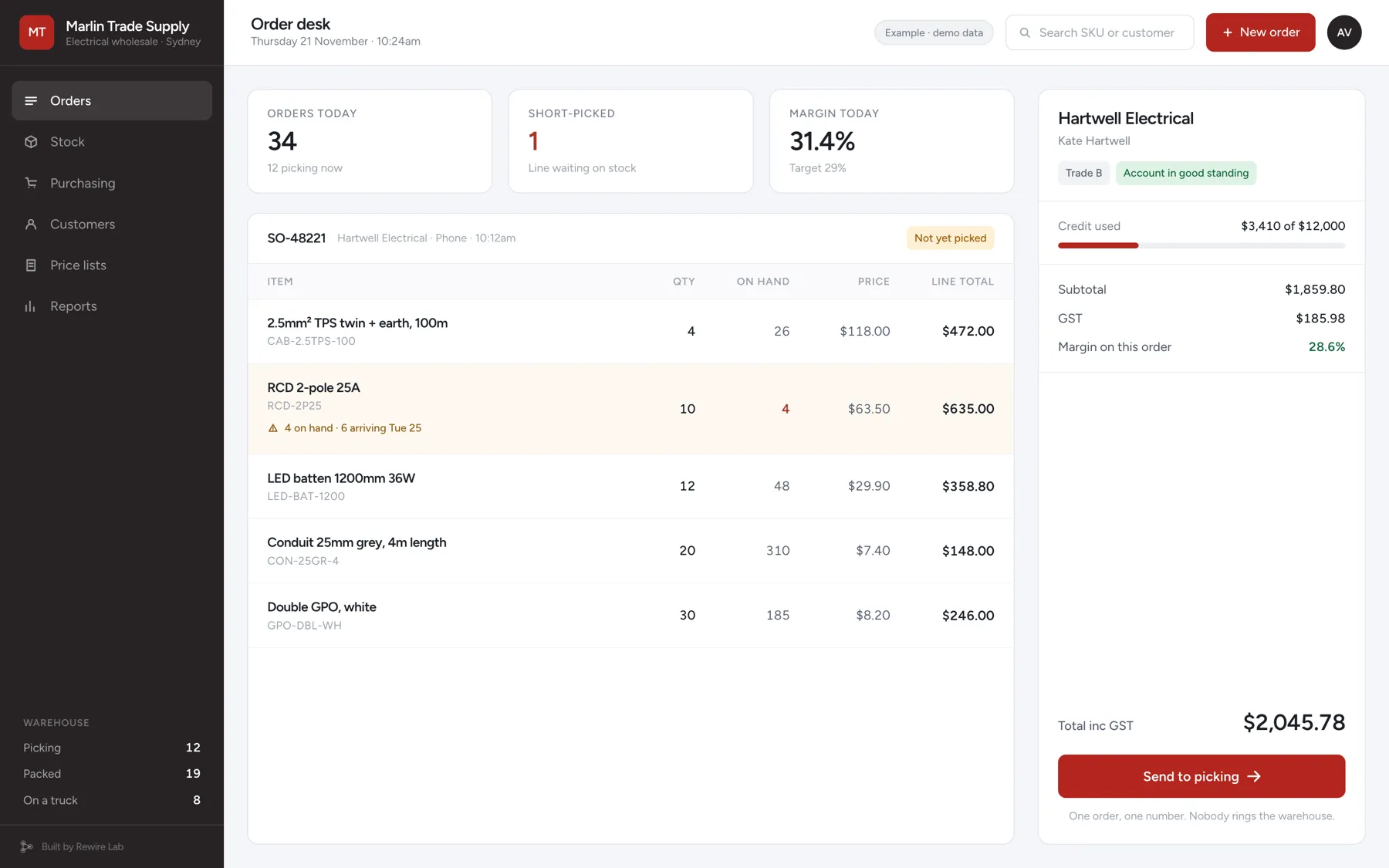
An order going in with the real stock sitting next to every line. One line is short — four on hand against ten ordered — and it is flagged before the customer is promised anything. The margin is worked out as it goes.
Pick a time. In 72 hours you'll be clicking on it.
Half an hour on a video call is all it takes to find out whether any of this is worth building. There's nothing to prepare and nothing to sign.
- 01
You walk us through a normal week
How orders, jobs or stock actually move. No prep, no documents — just show us the screens you use.
- 02
We work out what's costing you most
Out loud, on the call. You'll hear what software can fix and what it can't, whether you hire us or not.
- 03
Within 72 hours you get a prototype
Real screens of your system, running in your browser, built from that conversation. Not a slide deck and not a mock-up.
Signs it's time.
None of these are about how big you are. They're about whether the admin is growing faster than the business underneath it.
- Work handed over in conversation, so later nobody can say who has it or where it got to
- Stock counts that need correcting after every cycle
- A spreadsheet that one person understands and nobody else can touch
- Off-the-shelf software you pay for and half use
Your existing systems stay where they are.
Nothing gets ripped out. The system connects to what you already pay for and stops your team copying between them.
- Xero
- MYOB
- Shopify
- Bank feeds
- Stripe
- Australia Post
- Google Sheets
You see it working before you pay for it.
Most software projects ask you to approve a document and hope. This one shows you the thing first.
- 01Day 0
A 30-minute call
You walk us through how the work moves through your business today — the spreadsheets, the text messages, the thing only one person knows how to do. We record it, with your permission.
Nothing gets built on a guess.
- 02Within 72 hours
A prototype you can click
Real screens, built from that conversation, running in your browser. Not a slide deck and not a Figma file. You press it and tell us what's wrong.
You see your system working before you pay for it.
- 03Same week
A plan and a fixed price
Once we both agree on what it is, you get the build split into stages, each with a fixed price and a date. No open-ended hourly billing.
You know the price before you commit to anything.
- 04Week one
It goes live in pieces
Each stage ends with something your team actually uses, deployed to your own accounts. You're never waiting months to see progress.
Something new is running every week, on your accounts.
- 05The first month after
We stay on it
We watch it running and fix what comes up — the edge case nobody thought of, the report that needs one more column. You're not filing tickets into a void while your team works around a bug.
Included. You're not left alone with it the week after launch.
Three ways to get this built.
| Rewire Lab | Hiring in-house | A freelancer | |
|---|---|---|---|
| Something working before you pay | In 72 hours | You pay for months first | Deposit up front |
| Fixed price, agreed before the work | Yes — per stage | A salary, busy month or not | Hourly, open-ended |
| Time before it fits how you work | One call, then 72 hours | Hire first, then they learn it | Learns it on your clock |
| The month after launch | Included | Another month of salary | Billed hourly |
| You own the code and the accounts | From day one, documented | Only what they wrote down | Often not yours |
| Runs without you managing it | Yes | You manage a developer | You chase them |
| Cost to start | A 30-minute call | Salary + on-costs | Hourly from day one |
The ones that come up.
Do we have to throw out Xero?
No. Xero stays where it is and the system feeds it. Same for MYOB, your online store and your bank. The point is to stop people copying between them, not to replace what already works.
Our data is a mess. Is that a problem?
It's normal, and it's part of the job. We look at what you've got in the first week and decide what's worth migrating and what's better left behind.
How long before we're actually using something?
You'll see a working prototype within 72 hours of our first call, and the first real piece running in production inside the first week.
What happens after it goes live?
The first month is included. We watch it running and fix what comes up — the edge case nobody thought of, the report that needs one more column. After that we can stay on for support, or hand it over completely. It's your call, not a contract.
What happens if we stop working with you?
The code and the accounts are yours from day one, in your own repository and your own hosting. There's no lock-in and nothing to hand back.
Let's see if there's something worth building.
A free 30-minute call, no commitment. We go through how orders, jobs or stock move through your business and where the money leaks. You'll leave knowing what software can fix and what it can't — whether you hire us or not.
Book the call- 30 minutes, free, no obligation
- A working prototype within 72 hours
- A fixed price per stage, agreed before we start
- Nothing to pay until you've seen it